No products in the cart.

In Nanny, the psychological drama about displacement and resettlement, Anna Diop performs a model of herself. Like Diop, her character, Aisha, emigrated from Dakar, Senegal, and it is that exploration of id and belonging that almost all attracted Diop to Aisha. “I’ve at all times associated to the expertise of being alien and studying the best way to assimilate as a way to outlive,” she says. Diop immigrated to America almost three a long time in the past, and taking over this position, she says, allowed her to additionally honor her mom as a result of, by means of Aisha, she’s capable of present the struggles many immigrants bear to construct a greater life.
Within the movie, which received the Grand Jury Prize at this yr’s Sundance Movie Competition and hits theaters as we speak, Diop’s undocumented Aisha is employed to look after the daughter of a rich New York Metropolis couple, hoping to save lots of sufficient cash to deliver the younger son she left in Dakar. As his arrival approaches and Nanny progresses, the movie injects forceful African folklore spirits, Mami Wata and Anansi, that hang-out Aisha’s actuality and goals. Sierra Leonean-American filmmaker, Nikyatu Jusu, makes use of this to mystically present the risk to the American dream Aisha is making an attempt to achieve.
Chatting from the Park Lane resort over video on a wet Tuesday throughout the New York Movie Competition, Diop, 34, is wearing a large V-neck cream sweater with furry sleeves, her braided hair pulled up in an aesthetic bun. It did not take lengthy for us to bond over our African immigrant journeys, particularly when she talked about how a lot that helped her put together to play Aisha. “I used to be so enamored with the truth that I obtained to play a Senegalese lady as a result of I’ve not had the chance to try this earlier than,” she says with a twinkle of gratitude. “Nikyatu was so married to authenticity for this movie—she had written the script years in the past, however when she determined to solid me, she tweaked the script to suit the nuances of who I’m.” Jusu says she did so as a result of she’s “adamant about reasonable accents and casting ‘on sort’ reasonably than wedging the fallacious actor into a job they do not inhabit.”
Diop as Aisha in Nanny.
Amazon Studios
Exterior of that tailoring, to arrange for the position, Diop targeted on what she calls common character work, which included writing the biography of Aisha: a single mom longing to be reunited with the son she left again in her house nation; struggling to regulate to America in New York Metropolis; and battling microaggressions and abuses of energy within the office. She additionally did one thing she’d by no means achieved earlier than to arrange: used cork boards. On them, Diop wrote out each scene and color-coded those the place Aisha is experiencing psychosis—what leads to the movie as horror parts. Then, “I color-coded these towards the scenes the place I appear to be sane,” she says. Doing this helped her visualize the “ascension of madness” the character goes by means of.
Jusu says she was drawn to Diop for the position even earlier than casting as a result of her “humility, expertise and sweetness stood out to me at a time when a lot of our trade is about clout and velocity reasonably than an genuine dedication to the work.” Like Diop, Aisha’s expertise is one Jusu drew from inside, too, when writing and directing the movie. “I grew up in a Sierra Leonean family in Atlanta, a confluence of Black and southern tradition combined with a pervasive Black immigrant presence,” she says. “Mainstream media would not actually mirror the methods Black immigrants and Black People inherently intersect and work together in actual life.”
All through Nanny, Jusu explores these relationships alongside themes of colonialism and custom. From the music and Ankara clothes to the shows of ceebu jën, a standard Senegalese rice dish, such express representations of West Africa allowed Diop to additional have fun their tradition. “Nikyatu would tease me as a result of I used to be continually urgent her to mate Senegalese nuances,” Diop remembers. “And by chance, she was like, ‘Boy, you like your tradition, man. You simply will not let up on this.’” Diop even employed a dialect and accent coach to work together with her and her solid mates in order that they perfected the Senegalese dialect and native language, Wolof. “I needed it to be achieved proper,” she says. “All over the place I may, I used to be placing in little Senegalese.”
Diop’s journey to this primary lead position in a characteristic movie hasn’t been with out battle. It started with transferring to Houston, Texas, from Senegal in 1994. “It was very lonely,” she remembers. She was surrounded by her kinfolk in Senegal, however as soon as in America, it was simply her, her mother, and her dad, whom she had simply met as a result of they’d been “separated throughout oceans till I used to be 5.” She begged her mom to take her again as a result of “assimilation and studying this new place and growing your individual methods of surviving” was difficult and complicated.
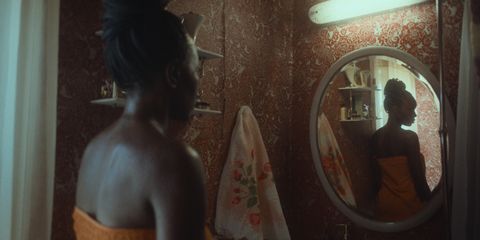
In Nanny, Diop’s Aisha turns into haunted by visions and African folklore spirits.
Amazon Studios
At house, her mother would cook dinner Senegalese meals, and her mother and father spoke Wolof. They had been elevating “me as a Senegalese particular person with Senegalese values within the faith and expectations of Senegalese women and girls,” she says, remembering nonetheless. “I might exit into the world, and it seems totally different, sounds totally different [with] totally different expectations [and] various things occurring.” As Diop adjusted, she relied on the immigrant group in Houston for refuge. “The folks I related most to had been different immigrants, it doesn’t matter what their race was as a result of we each shared a twin existence…We each went house and had one tradition after which went out into the world and needed to be on this [other] tradition,” she says. “I had loads of Indian mates rising up. One in all my finest mates is Vietnamese. However much like me, all of them both had been first technology or got here [to the U.S.] once they had been very younger, too. In order that’s how I survived.”
She first fell in love with performing at 12 when she chanced on a screenplay written by a household good friend. It was her first time studying one. The fictional world, plus the characters and dialogue, fascinated her. “It is form of cliché,” she says, laughing flippantly, however “I caught the performing bug and obtained my mother and father to enroll me in a theater group in Houston.” Not lengthy after that, she joined the theater troupe in school and have become “a theater dork” till she graduated highschool and moved to Los Angeles by herself to pursue performing full-time.
She took performing lessons in LA, studied Shakespeare at Oxford one summer season, then moved to New York Metropolis to check some extra underneath famend coaches. “I by no means needed one other actor to know one thing about performing that I did not know,” she says of her hustle. “Whether or not it was approach, whether or not it is a e book they learn, something.” Diop was “very decided to make it work.” She credit the audacity of youthful hope for the progress she’s had within the trade. “I do not know that I’d ever have been profitable if I did not begin after I was 17.” She met her agent in a kind of performing lessons and inched into the trade by means of industrial and modeling work.
“The folks I related most to had been different immigrants, it doesn’t matter what their race was as a result of we each shared a twin existence”
That meant plenty of appointments and auditions—and rejection. In a single assembly, Diop remembers a high-profile supervisor, a white man, telling her, “‘Your pores and skin is just too deep, you are too darkish to actually work. You are not going to search out constant work. It is simply not going to be the truth.’” On the time, Diop says, being a dark-skinned lady wasn’t “in” till Lupita Nyong’o received her Oscar in 2013, “and she or he blew so many doorways open. ” Nyong’o’s rise grew to become pivotal in how dark-skinned ladies like Diop had been obtained in an trade lengthy infested with racism, sexism, and colorism, particularly for ladies of coloration.
By 25, Diop had a breakthrough position as a collection common on the short-lived The Messengers, which first aired on the CW in 2015. Earlier than reserving the collection, Diop’s casting character description requested for a “Lupita Nyong’o, a younger Viola Davis sort… They had been saying that due to the success of Lupita,” Diop remembers. “She was good in [12 Years a Slave], was so attractive and gracious all through all her press. And he or she was scorching. And the trade simply follows what’s scorching. So I like her for ceaselessly—she positively opened loads of doorways.”
Changing into a collection common was an important step for Diop as a result of it meant breaking into movie was subsequent, “and the following area after that’s remaining in movie in an impactful approach,” she says. (Diop feels “TV is changing into so unimaginable now—we’ve Nicole Kidman and De Niro doing tv, in order that’s modified.”) And although that first collection wasn’t what she’d hoped it might be, canceling simply after the primary season, she’s since been booked and busy. On TV, she’s starred in Bosch, Titans, 24: Legacy, and Greenleaf. In movie, she’s been in Fabrice Du Welz’s Message from the King, starring the late Chadwick Boseman, and Jordan Peele’s horror 2019 movie Us, starring Nyong’o.
Working with Peele on Us was notably memorable for Diop as a result of his total tone on set grew to become indicative of the form of inclusive area she needed to be in as she progressed in Hollywood. “Being in his orbit is superb,” she says. “He is one of the light, type filmmakers and other people on this trade that I’ve ever met.” Throughout filming, for instance, when the hair and make-up workforce needed to place her in a wig, Peele mentioned, “‘Put on your pure hair, that is what I need,'” she remembers, “and I am like, I like him .”
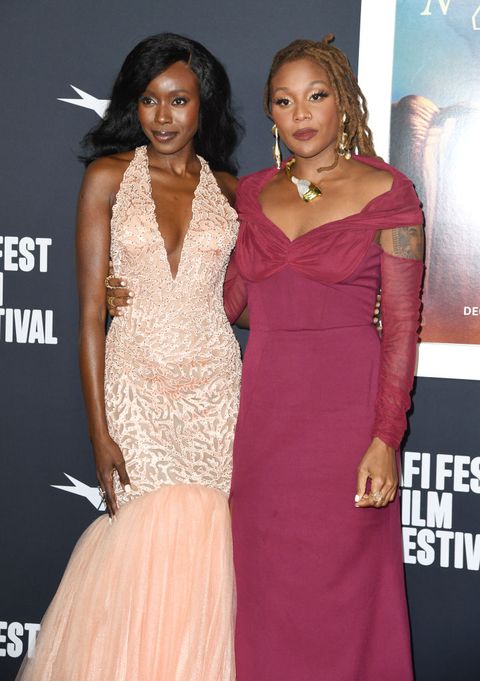
Diop and Jusu at a Nanny screening in Hollywood on Nov. 3.
JC Olivera//Getty Pictures
That very same vibe is what drew her to Jusu and Nanny. To have the ability to stroll on set and be authentically herself, surrounded by individuals who knew its significance, cemented how far such inclusive areas may breed much more free expression and creativity. That have has since “spoiled” her as a result of it is elevated her expectations for the varieties of roles she’d settle for going ahead. “I am in dialog on a couple of issues, however I have been very choosy,” she says, smiling large. “I do not need to return. I need to stay at this degree of artistry with filmmakers like Nikyatu.”
Diop hopes audiences stroll away from Nanny with a deeper, extra empathetic view of the plights of immigrants and people from underprivileged backgrounds who work invisible jobs to make life occur for his or her households. The movie can be a love letter, she says, to “immigrants and other people working in these positions to really feel seen by means of Aisha’s character.”
Nanny is now displaying in theaters and begins streaming on Prime Video Dec. 16
Styled by Molly Dickson; Hair by LaRae Burress; Make-up by Shannon Pezzetta.
Rita Omokha is a contract author based mostly in New York who writes about tradition, information, and politics.